

Atomized Ferro Silicon Powder Supplier
Choosing a ferro silicon powder supplier can look easy from the outside.
You check the price. You check the silicon percentage. You ask about delivery. Maybe you compare two or three quotations and select the one that looks better.
But anyone working in a foundry knows that the real story starts after the material reaches the plant.
A powder can look fine on paper and still create problems during actual production if its chemistry, particle size, flow, moisture level, or batch consistency is not properly controlled.
This is why selecting an atomized ferro silicon powder supplier should not be based on price alone.
The better question is:
Will this supplier give us material that behaves consistently every time we use it?
That is the part worth evaluating carefully.
First, Understand What Your Process Actually Needs
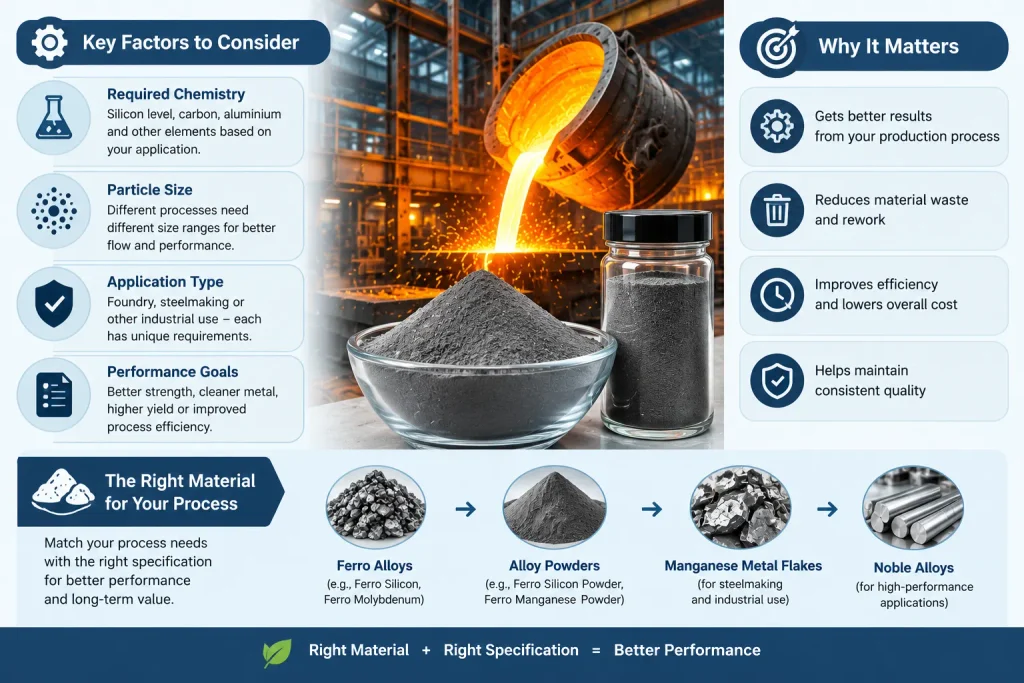
Before speaking to suppliers, it is useful to understand your own requirement.
There is no single ferro silicon powder specification that works for every application.
The required silicon level, particle size and other characteristics can change depending on the process and the way the material is being added.
A foundry may need a particular size distribution for feeding or treatment. Another application may require a different chemistry or physical form.
So instead of asking a supplier:
“What ferro silicon powder do you have?”
it is better to ask:
“Can you supply the ferro silicon powder required for our process and specification?”
That small change in the question can save a lot of trouble later.
1. Check the Chemical Composition Properly
This sounds obvious, but it is one of the first things that should be checked.
Do not look only at the silicon percentage.
Ask for the complete chemical specification.
Depending on your application, you may want to review elements such as:
- Silicon
- Carbon
- Aluminium
- Sulphur
- Phosphorus
- Iron
- Other specified impurities
The acceptable limits will depend on the grade and application.
The important thing is that the supplier should be able to clearly state what they are supplying.
A proper test certificate or certificate of analysis for the material is much more useful than a simple statement saying “high quality.”
In industrial purchasing, numbers are better than adjectives.
2. Particle Size Is Not a Small Detail
This is probably one of the areas that deserves more attention.
When buying powder, people naturally focus on chemistry first.
But particle size can affect how the material behaves during handling and addition.
If the size distribution changes considerably from one batch to another, you may notice differences in:
- Feeding
- Flow
- Dispersion
- Reaction or dissolution
- Dust generation
- Material handling
Atomized material is generally produced by breaking molten alloy into droplets that solidify into particles. The resulting physical form can be useful where more controlled particle characteristics are required.
But simply calling something “atomized” does not tell you everything.
Ask the supplier for the actual particle-size range.
Also ask whether they can maintain that range consistently.
A supplier who can give you a clear particle-size specification is easier to evaluate than one who only provides general descriptions.
3. Ask About Batch-to-Batch Consistency
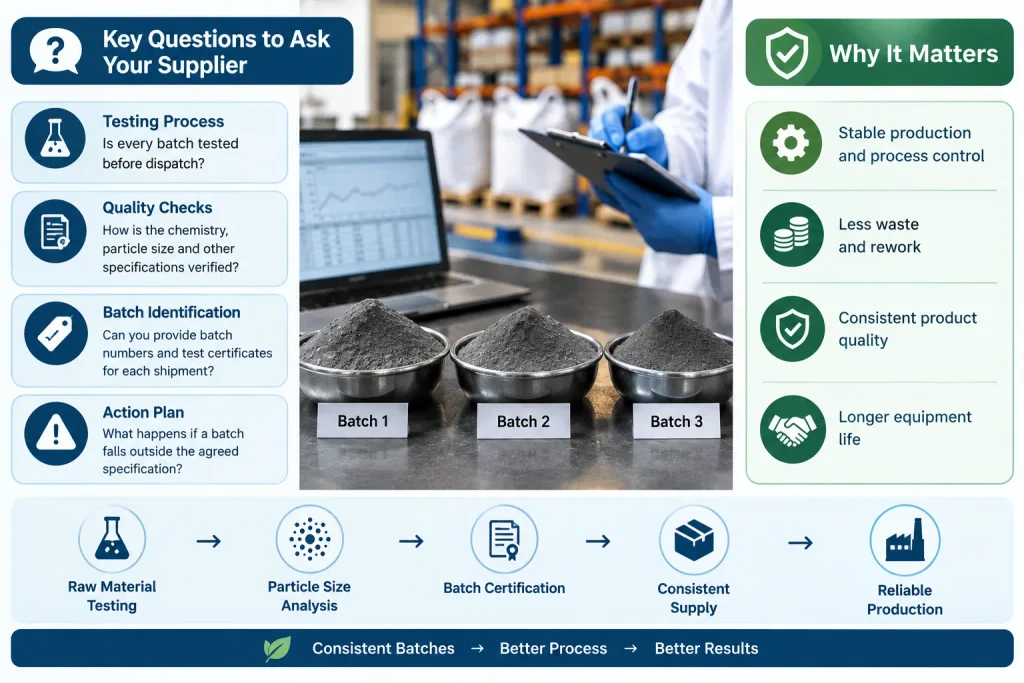
This is where many purchasing decisions become interesting.
One sample may be excellent.
But what happens with the tenth shipment?
Industrial production does not run on samples. It runs on repeated batches.
A good supplier should have a system for maintaining consistency between batches.
You can ask questions such as:
- Is every batch tested?
- How is the chemistry checked?
- How is particle size monitored?
- Is batch identification available?
- Can test certificates be provided?
- What happens if a batch falls outside the agreed specification?
These are not difficult questions.
And a serious supplier should be comfortable answering them.
4. Look at the Supplier’s Quality Testing System
You do not necessarily need a supplier with the biggest laboratory or the most impressive equipment.
What matters is whether the supplier actually uses proper testing as part of its production process.
For ferro alloy powders, quality checks may involve chemical analysis and physical checks such as particle-size evaluation and moisture control, depending on the product and application.
A supplier with a proper testing system is better positioned to identify variation before the material reaches the customer.
For buyers, this also means fewer surprises.
DS Alloyd states that it operates an analytical laboratory for analysing input and output materials and has quality-control processes as part of its manufacturing setup.
5. Do Not Ignore Moisture and Storage Conditions
Powder materials need sensible storage and handling.
Moisture can create handling problems and may affect the condition of the material during storage.
Ask the supplier:
How is the powder packed?
Then ask:
How is it stored before dispatch?
And, if your material will sit in your warehouse for some time:
What storage conditions do you recommend?
These questions are easy to overlook when everything is focused on price.
But a material that has been poorly stored is not going to become better simply because its original specification was good.
Packaging should protect the product during transportation and storage.
6. Ask About Dust and Handling Behaviour
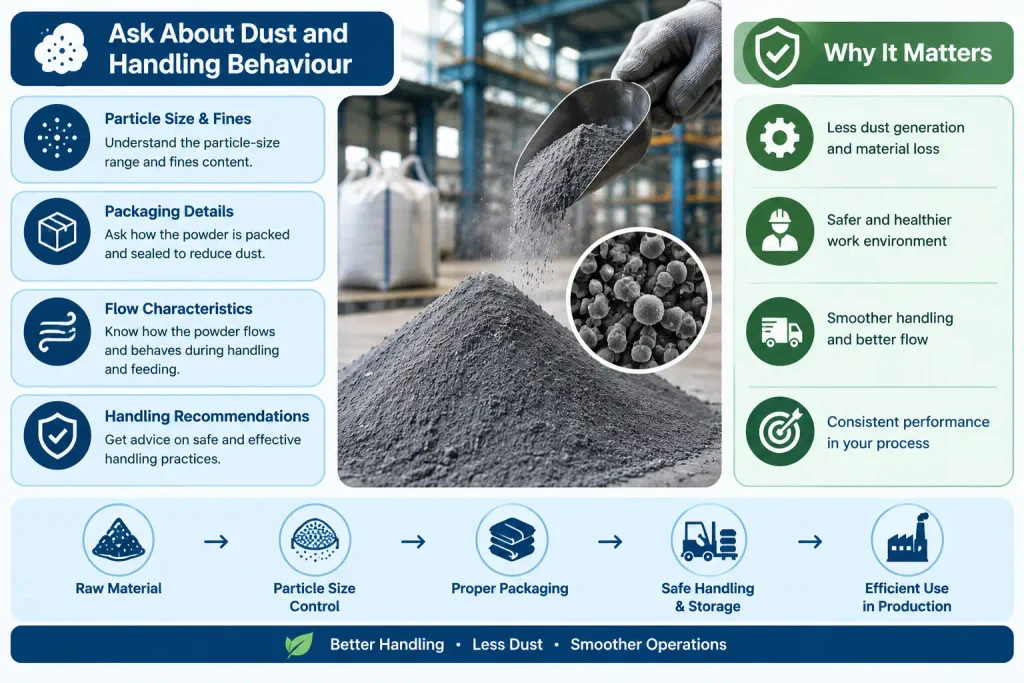
Anyone who has worked around industrial powders knows that handling is a practical issue.
Very fine material can create more dust during transfer, feeding, or movement.
That can affect housekeeping and operator comfort, apart from increasing material losses.
This is one reason physical characteristics should be discussed with the supplier rather than assuming that all ferro silicon powders behave in the same way.
Ask about:
- Particle-size distribution
- Fines content
- Packaging
- Flow characteristics
- Recommended handling practices
You may not need the most expensive powder.
You need the powder that works properly with your existing handling system.
7. Compare Suppliers on More Than Price
Let us say Supplier A is offering material at a lower price.
Supplier B is slightly more expensive.
At first, Supplier A looks like the obvious choice.
But then you discover that Supplier B provides:
- More consistent batches
- Proper test documentation
- Better particle-size control
- More reliable delivery
- Better technical communication
Now the calculation changes.
A cheaper material is not actually cheaper if it causes additional adjustments, production interruptions, rejected material, or repeated quality checks.
This is why industrial buyers should look at total cost, not just purchase price.
Sometimes paying slightly more for predictable material is the cheaper decision in the long run.
8. Check Supply Capacity Before Placing Large Orders
A supplier may be able to provide one truck or one small shipment without any issue.
But can they handle your regular requirement?
This matters if your production is continuous.
Before finalizing a supplier, discuss:
- Monthly requirement
- Minimum order quantity
- Standard packing
- Lead time
- Delivery location
- Emergency requirements
- Ability to scale supply
A supplier should understand your expected consumption rather than treating every order as a completely separate transaction.
Reliable planning on both sides makes procurement much easier.
9. Ask for a Trial Before Making a Long-Term Decision
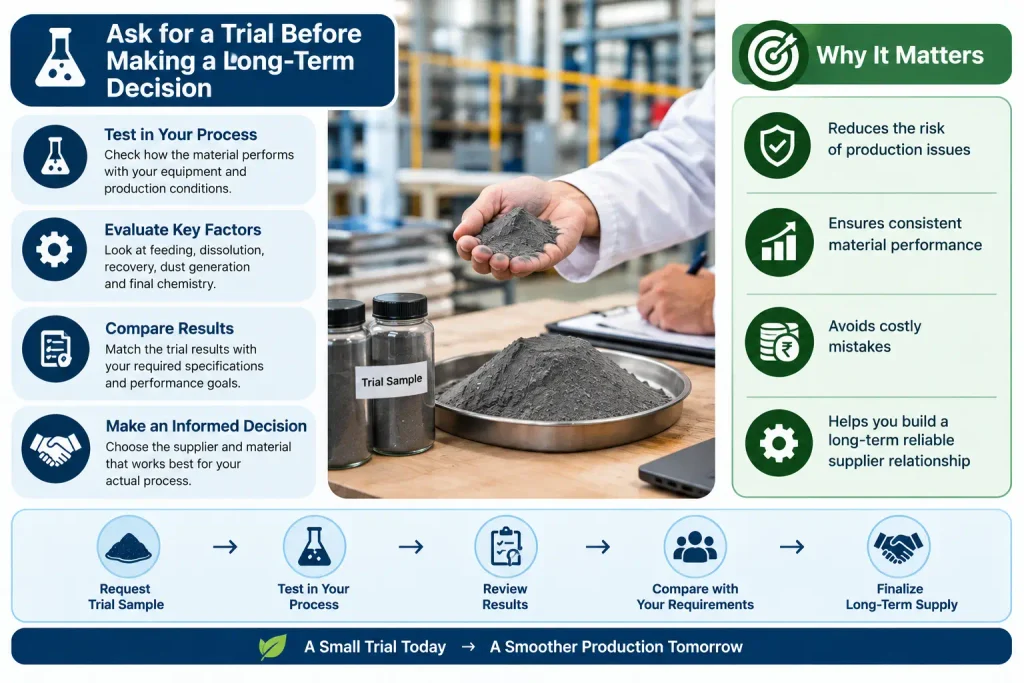
If the material is important to your process, a trial order is usually worth considering.
Do not make a long-term decision only because the supplier has sent a nice brochure.
Test the material in your actual process.
Look at things such as:
- Feeding behaviour
- Melting or dissolution behaviour
- Recovery
- Dust generation
- Final chemistry
- Production consistency
Your own production conditions matter.
A material that works well in another plant may behave differently when your feeding system, furnace conditions, temperatures, or operating practices are different.
The trial tells you much more than a sales conversation.
10. Check How the Supplier Handles Problems
This is an underrated question.
Everybody talks about quality when everything is going well.
The better test is what happens when something goes wrong.
Suppose a batch arrives and your quality team finds a problem.
Who do you contact?
How quickly do they respond?
Do they investigate the batch?
Can they trace the material?
Do they provide a corrective action?
A dependable supplier should have a clear communication process.
In manufacturing, problems will occasionally happen. What matters is how quickly and professionally they are handled.
11. Documentation Should Be Easy to Understand
Good documentation does not need to be complicated.
The basic information should be clear.
Depending on your requirements, you may want:
- Product specification
- Chemical analysis
- Particle-size information
- Batch number
- Packing details
- Certificate of analysis
- Safety or handling information where applicable
- Dispatch information
If your quality team has to chase the supplier every time they need basic information, it can become frustrating very quickly.
Good documentation saves time on both sides.
12. Look at the Supplier’s Wider Product Knowledge
A supplier who understands only how to sell a bag of powder is different from a supplier who understands alloy materials and industrial production.
This does not mean the salesperson needs to be a metallurgist.
But the company should understand why the customer is using the material.
Ferro silicon powder is only one material in a larger metallurgical environment.
Foundries and steel manufacturers may also work with manganese, chromium, molybdenum, vanadium, niobium and other alloying materials.
Having a supplier with wider alloy knowledge can make communication easier, especially when material requirements change.
A Simple Checklist Before You Finalize the Supplier
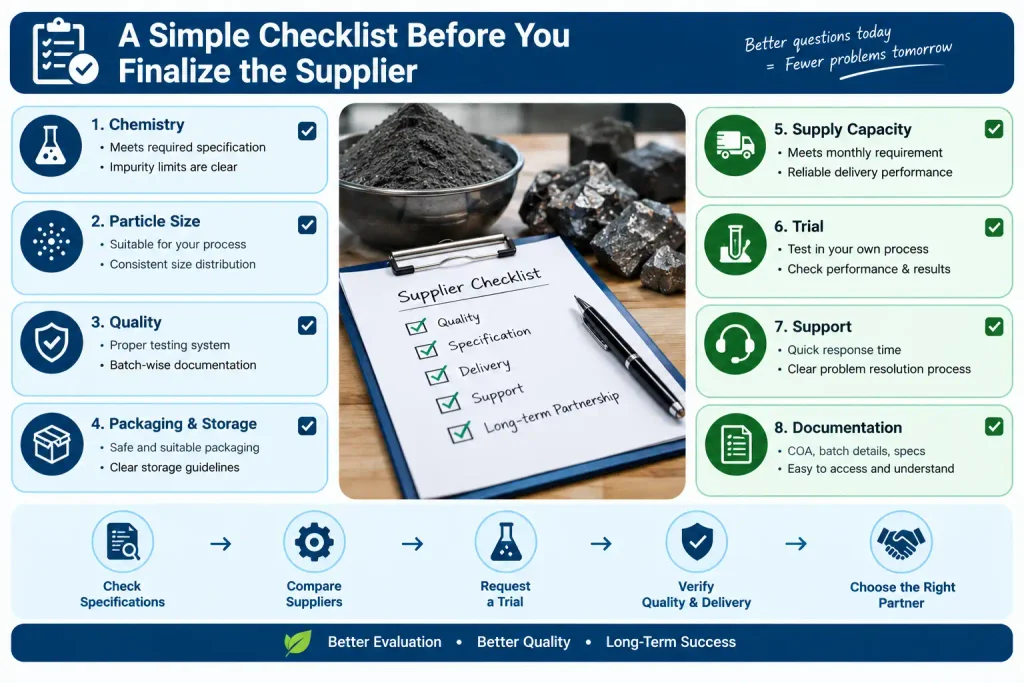
Before placing a long-term order, ask yourself these questions:
Chemistry
- Does the material meet our required chemical specification?
- Are impurity limits clearly defined?
Particle Size
- Is the particle-size range suitable for our process?
- Is the size distribution consistent?
Quality
- Does the supplier test the material?
- Can they provide batch-wise documentation?
Handling
- Is the packaging suitable?
- How should the powder be stored?
Supply
- Can they meet our monthly requirement?
- Is their delivery performance reliable?
Trial
- Have we tested the material in our own process?
Support
- Can we reach someone quickly when there is a problem?
If the answer to most of these questions is yes, you are probably looking at a supplier worth considering.
Why Consistency Often Matters More Than a Very Low Price
This is probably the biggest takeaway from the whole discussion.
In manufacturing, small variations can become big headaches when they happen repeatedly.
A supplier who delivers consistent material allows production teams to work with fewer surprises.
That does not mean every supplier with a higher price is better.
It simply means price should be considered together with quality, consistency, delivery and technical support.
The best supplier is usually the one who gives you predictable material and predictable service.
That is much more valuable than a cheap quotation that creates problems later.
Where DS Alloyd Pvt Ltd Fits Into the Alloy Supply Chain
DS Alloyd Pvt Ltd works with ferro alloys, noble alloys, pure metals and ferro alloy powders for industrial applications. Its current product range includes materials such as Ferro Molybdenum, Ferro Vanadium, Ferro Niobium, Manganese Metal Flakes and several ferro alloy powders.
The company also highlights quality control, analytical testing and manufacturing infrastructure as part of its approach to alloy production.
While choosing any supplier, the same basic rule applies: understand your specification first, ask practical questions, test the material where possible, and then decide based on overall value.
Looking for a Reliable Alloy Supplier?
If your business is sourcing alloy materials for steelmaking, foundry or other industrial applications, DS Alloyd Pvt Ltd can be a useful supplier to evaluate.
The company supplies Manganese Metal Flakes and Noble Alloys, along with other alloy materials for industrial requirements.
You can explore the product range and discuss your material requirement directly through the DS Alloyd Pvt Ltd website.
Frequently Asked Questions
Start with your required chemical composition and particle-size specification. After that, check batch consistency, testing, packaging, supply capacity and delivery reliability.
Particle size can influence handling, feeding, dispersion and the behaviour of the material during use. The correct size depends on the particular application and process.
Not necessarily. A lower purchase price can become expensive if inconsistent material creates additional process adjustments, waste, rejected products or delays.
Yes. A certificate of analysis can help your quality team verify that the supplied batch meets the agreed chemical requirements.
For an important production material, a trial is a sensible step. Testing the powder in your own process gives you a better understanding of how it actually performs.
Ask for the actual particle-size range, size distribution and method used to control or test the size. Also explain how the powder will be fed or used in your process.
Consistent batches make production more predictable. When the material keeps changing, operators may have to make additional adjustments, which can make process control more difficult.
Look at delivery reliability, documentation, technical support, packaging, response time and the supplier’s ability to maintain supply as your requirement grows.
Final Thoughts
Choosing an atomized ferro silicon powder supplier should not be treated like buying an ordinary commodity.
The material becomes part of your production process.
So, the right supplier is not simply the one offering the lowest number on a quotation. It is the supplier that understands specifications, controls quality, maintains consistency and can keep supplying the material when you need it.
Take the time to ask questions before finalizing the supplier.
A little extra checking at the beginning can save a lot of unnecessary trouble later.
