

Introduction
When manufacturers talk about alloy quality, most of the attention usually goes to the finished product. People discuss tensile strength, corrosion resistance, heat resistance, and durability. But very few conversations start with the raw materials that make those properties possible.
One of those critical materials is Ferro Molybdenum.
Used widely in steelmaking, foundries, engineering alloys, and specialty metal production, Ferro Molybdenum plays an important role in improving strength, hardness, wear resistance, and high-temperature performance. However, the benefits of Ferro Molybdenum depend heavily on its purity and consistency.
Not all Ferro Molybdenum available in the market performs the same way. Small variations in composition, impurity levels, particle size, and manufacturing processes can affect the final quality of steel and alloy products.
This is why choosing the right supplier is often just as important as choosing the right material.
If your production process depends on reliable alloying performance, partnering with a supplier that consistently delivers high-purity Ferro Molybdenum can make a measurable difference.
What Is Ferro Molybdenum?
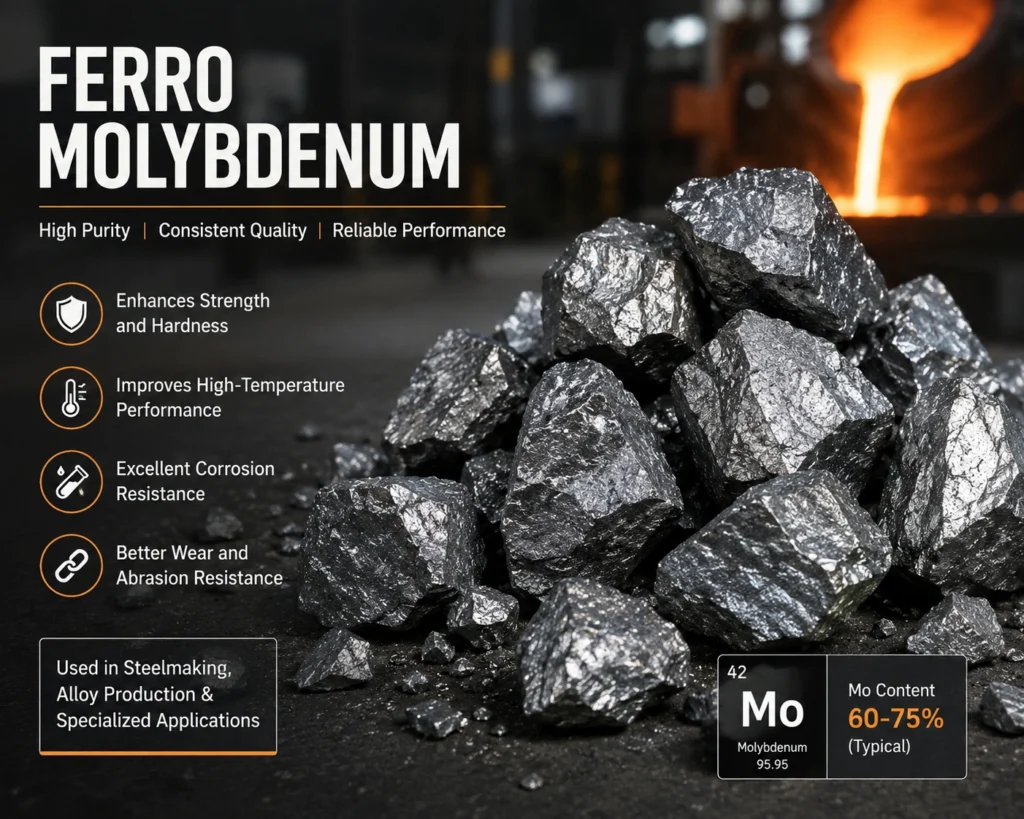
Ferro Molybdenum, commonly called FeMo, is an alloy primarily composed of iron and molybdenum. It is used as an additive during steelmaking and alloy production to introduce molybdenum into the metal efficiently.
The molybdenum content typically ranges between 60% and 75%, depending on grade and application requirements.
Manufacturers use Ferro Molybdenum because pure molybdenum is difficult and expensive to add directly during steel production. Ferro Molybdenum offers a practical and cost-effective alternative while maintaining precise alloy chemistry.
Why Molybdenum Matters in Steel and Alloys
Molybdenum is not added to steel simply as a filler element.
It contributes directly to performance characteristics that many industries rely on every day.
These include:
- Improved tensile strength
- Enhanced hardness
- Better corrosion resistance
- Greater resistance to wear and abrasion
- Higher creep resistance at elevated temperatures
- Improved weldability in certain alloy grades
- Better performance under extreme pressure
This is one reason why molybdenum-containing steels are commonly used in sectors such as:
- Oil and gas
- Construction
- Aerospace
- Automotive manufacturing
- Mining equipment
- Power generation
- Heavy engineering
- Defense applications
Without proper molybdenum addition, achieving these properties becomes much more difficult.
Why High Purity Makes a Difference
Many buyers focus on price first.
While cost is important, Ferro Molybdenum is not a material where cutting corners usually pays off.
The quality of the alloy can directly influence downstream production.
High-purity Ferro Molybdenum offers several advantages.
More Predictable Alloy Chemistry
Steel producers need precise control over chemical composition.
When impurity levels fluctuate from batch to batch, maintaining consistency becomes challenging.
High-purity material provides more predictable alloying results and reduces process variations.
Reduced Material Losses
Lower-quality Ferro Molybdenum may contain unwanted elements that do not contribute to the desired steel chemistry.
As a result, manufacturers often need additional corrections during production.
Using cleaner material can help reduce alloy consumption and improve recovery rates.
Better Product Quality
Consistent Ferro Molybdenum quality supports consistent steel quality.
This becomes especially important when producing:
- High-strength steels
- Stainless steels
- Tool steels
- Pressure vessel steels
- Heat-resistant alloys
A small inconsistency in raw materials can create larger quality issues later.
Lower Production Risks
Unexpected variations in alloy composition can cause delays, rework, and increased production costs.
Reliable Ferro Molybdenum helps minimize these risks.
Common Problems Buyers Face When Sourcing Ferro Molybdenum
Many procurement teams encounter challenges that are not immediately visible during purchasing.
Some common issues include:
Inconsistent Chemical Composition
A supplier may provide acceptable quality in one shipment but inconsistent quality in the next.
This inconsistency can create operational difficulties for manufacturers who rely on repeatable production processes.
Supply Chain Delays
Production schedules often depend on timely alloy deliveries.
Late shipments can disrupt manufacturing timelines and affect customer commitments.
Insufficient Documentation
Industries with strict quality standards require proper material certifications and traceability.
Without complete documentation, quality verification becomes difficult.
Poor Technical Support
Some suppliers simply sell material without understanding the customer’s production requirements.
A knowledgeable supplier can often help optimize alloy usage and improve efficiency.
What to Look for in a Ferro Molybdenum Supplier
Finding the right supplier involves more than comparing quotations.
Here are several factors worth evaluating.
Quality Assurance Systems
Look for suppliers that follow established quality control procedures and conduct regular testing.
Reliable testing helps ensure every batch meets specifications.
Consistency Across Shipments
Consistency often matters more than occasional high-quality batches.
Long-term production stability depends on receiving dependable material every time.
Industry Experience
Suppliers with experience in alloy and metallurgical industries usually understand customer requirements better.
Their expertise can help prevent technical issues before they occur.
Reliable Inventory Management
A strong supplier should have the ability to support ongoing production requirements without frequent stock shortages.
Technical Knowledge
The best suppliers understand how their products perform inside real manufacturing environments.
This knowledge becomes valuable when customers face process challenges.
The Hidden Cost of Low-Quality Ferro Molybdenum
The purchase price is only one part of the equation.
A cheaper material can create additional costs through:
- Production inefficiencies
- Increased alloy consumption
- Quality rejections
- Reprocessing expenses
- Equipment downtime
- Delayed deliveries
- Customer complaints
Many manufacturers discover that paying slightly more for dependable quality actually lowers overall operating costs.
In metallurgy, consistency often creates greater value than short-term savings.
Growing Demand for High-Performance Alloy Materials
Industries worldwide are demanding stronger, lighter, and more durable materials.
Modern engineering applications require metals that can perform under increasingly challenging conditions.
This trend has increased the importance of specialty alloying elements such as molybdenum.
As industries continue investing in advanced infrastructure, renewable energy projects, industrial machinery, and transportation systems, demand for high-quality alloy materials is expected to remain strong.
Manufacturers that prioritize raw material quality today are often better positioned to meet future performance requirements.
Why Choosing the Right Alloy Partner Matters
The relationship between a manufacturer and an alloy supplier should go beyond transactions.
A dependable supplier contributes to:
- Consistent production quality
- Stable supply chains
- Better process efficiency
- Reduced operational risks
- Long-term business growth
When alloy materials directly influence product performance, supplier selection becomes a strategic decision rather than a purchasing decision.
Looking for Reliable Alloy Material Solutions?

If your business depends on high-quality alloy materials, working with an experienced and trusted supplier can make a significant difference.
Dsalloyd Pvt Ltd supplies premium metallurgical products, including Manganese Metal Flakes and Noble Alloys, serving industries that require consistency, quality, and dependable supply.
Whether you are involved in steel manufacturing, foundry operations, alloy production, or industrial metal processing, the team at Dsalloyd Pvt Ltd focuses on delivering materials that support reliable manufacturing outcomes.
To learn more about their product range and alloy solutions, visit: https://www.dsalloyd.com/
Investing in quality raw materials today helps build stronger, more reliable products tomorrow.
Frequently Asked Questions (FAQs)
Ferro Molybdenum is primarily used as an alloying additive in steel and specialty alloy production. It improves strength, hardness, corrosion resistance, and high-temperature performance.
High-purity Ferro Molybdenum provides more consistent alloy chemistry, reduces impurities, improves production efficiency, and helps achieve reliable material performance.
Industries such as aerospace, automotive, oil and gas, construction, mining, power generation, and heavy engineering frequently use molybdenum-containing alloys.
Low-quality material may cause inconsistent alloy composition, increased production costs, quality issues, material wastage, and operational delays.
Key factors include product quality, consistency, testing standards, industry experience, technical support, inventory availability, and supply reliability.
Yes. Molybdenum helps improve corrosion resistance, especially in stainless steels and alloys exposed to aggressive environments.
Molybdenum increases creep resistance and helps metals maintain strength and stability at elevated temperatures.
Companies looking for reliable alloy material solutions can explore the product range offered by Dsalloyd Pvt Ltd, including Manganese Metal Flakes and Noble Alloys for various industrial applications.
