

Titanium Levels in Steelmaking
Titanium is used in steelmaking for a reason, but adding titanium is not simply a matter of putting a fixed quantity into molten steel and expecting the same result every time.
In many steel grades, titanium has to be kept within a fairly controlled range. Too little titanium may mean the required metallurgical effect is not achieved. Too much can also create problems, especially when titanium combines with nitrogen and carbon and forms compounds such as titanium nitride (TiN) and titanium carbide.
This is where ferro titanium becomes useful.
Ferro titanium gives steelmakers a practical way to introduce titanium into molten steel while keeping the addition measurable and easier to control than adding pure titanium directly.
But there is an important point here: the titanium percentage written on a ferro titanium specification sheet is not the same thing as the titanium percentage that will finally remain in the steel.
The actual result depends on addition quantity, recovery, steel temperature, oxygen level, slag condition, addition method, particle size and other process conditions.
So, how does ferro titanium help control titanium levels? Let’s look at it in a simple way.
What Is Ferro Titanium?
Ferro titanium is a ferroalloy made mainly from iron and titanium. It is used as a source of titanium during steelmaking and other metallurgical processes.
Instead of trying to add pure titanium to a steelmaking process, the titanium is introduced through an alloy that can be weighed, measured and added according to the requirements of the heat.
The exact grade of ferro titanium can vary depending on the application and required titanium content.
For a steelmaker, the important thing is not only the nominal titanium content of the alloy. The bigger question is:
How much titanium will actually be recovered in the steel?
That is where process control becomes important.
Why Does Steel Need Controlled Titanium?
Titanium is a strong alloying and microalloying element.
Depending on the steel grade and processing route, controlled titanium additions can be used for effects such as grain refinement, precipitation control and stabilization of certain elements.
Titanium also has a strong affinity for nitrogen and can form TiN particles. These particles can be useful when their size and distribution are properly controlled, but excessive or coarse TiN can have unwanted effects on steel properties.
Research on titanium-containing microalloyed steels has shown that titanium and nitrogen levels need to be controlled carefully because excessive TiN formation can affect grain refinement and other properties.
This is why steel plants normally work toward a target titanium range, rather than simply trying to add “more titanium.”
Ferro Titanium Makes the Addition Easier to Measure
One of the basic advantages of ferro titanium is that it provides titanium in a form that can be weighed and added in a controlled quantity.
Suppose a steel grade needs a specific increase in titanium.
The steelmaker first considers:
- Current titanium level in the heat
- Required final titanium level
- Titanium percentage in the ferro titanium
- Expected titanium recovery
- Weight of the steel heat
- Addition method
- Other process conditions
This gives the plant a much better basis for deciding how much ferro titanium to add.
A simplified way of thinking about the calculation is:
Required alloy addition = Required titanium addition ÷ (Titanium fraction in FeTi × Expected recovery)
It is only a simplified calculation because actual steelmaking conditions can change recovery, but it shows an important point: recovery has to be considered when deciding the additional quantity.
Titanium Recovery Is a Big Part of the Calculation
This is probably one of the most important things to understand about ferro titanium.
If a steelmaker adds a certain quantity of FeTi, it does not automatically mean that 100% of the titanium will become part of the final steel chemistry.
Titanium is highly reactive, particularly toward oxygen. Recovery can therefore change depending on conditions in the ladle and the way the alloy is introduced.
Research on industrial steelmaking has found that titanium recovery can be influenced by factors such as dissolved oxygen, slag chemistry, addition method, bath flow and steel temperature.
This means that two heats receiving a similar ferro titanium addition may not always finish with exactly the same titanium level if the process conditions are different.
For this reason, experienced steel plants normally use their own historical process data to understand the expected recovery for a particular grade and addition practice.
The Addition Method Also Matters
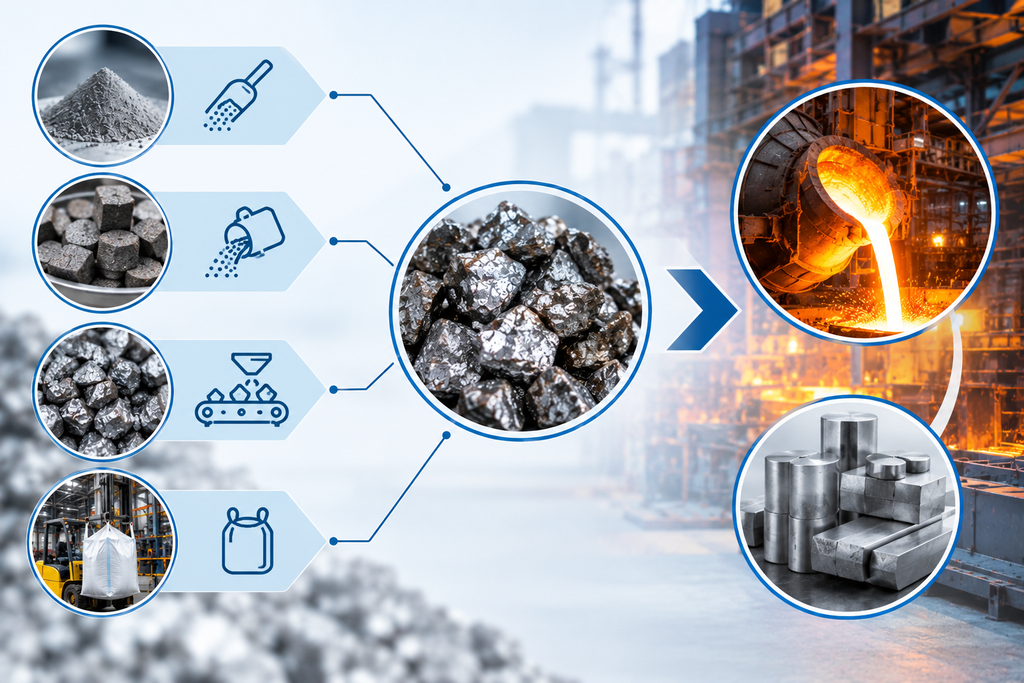
Ferro titanium can be introduced into steel through different addition practices.
The choice depends on the steel plant, equipment and grade being produced.
The timing of the addition matters because the steel chemistry and temperature are changing throughout secondary steelmaking.
If the alloy is added at the wrong stage, there may be greater losses or less predictable recovery.
In some operations, wire injection is used because it gives better control over where and how the alloy enters the molten steel. Other plants may use different addition methods depending on their equipment.
The main idea is simple:
The alloy and the addition method have to work together.
Buying a good ferro titanium grade alone does not guarantee good titanium recovery.
Why Oxygen Control Matters
Titanium reacts very readily with oxygen.
This is one reason titanium recovery can be difficult to predict when the steel contains higher levels of dissolved oxygen or when slag conditions are not properly controlled.
When titanium reacts with oxygen, part of the titanium can be tied up in oxide inclusions rather than contributing to the intended dissolved titanium level.
This does not mean oxygen control is the only factor. Slag chemistry, temperature, mixing and addition practice also have an effect.
For steelmakers, this means ferro titanium addition should be considered as part of the whole secondary steelmaking process, not as an isolated step.
Particle Size Can Also Affect Addition Behaviour
Another point that is sometimes overlooked is the physical form of the ferro titanium.
Particle or lump size can influence how quickly the alloy enters and dissolves into the molten steel.
If the material is not suitable for the plant’s addition system, the operator may experience problems with feeding, dissolution or recovery.
This is especially important when a plant has a fixed feeding system and expects alloy material within a particular size range.
So, when buying ferro titanium, it is useful to ask about more than chemical composition.
The physical specification matters too.
Why Batch-to-Batch Consistency Is Important
Imagine a steel plant has established an addition practice based on a particular ferro titanium grade.
If the titanium content changes significantly from one shipment to another, the plant may need to adjust its addition calculations.
The same problem can happen when impurity levels or physical sizing change.
Consistent material makes process control easier because the steelmaker can work from a more predictable starting point.
This is particularly important for steel grades where titanium has a narrow target range.
A supplier’s certificate of analysis and batch information can therefore be useful. It gives the purchasing and production teams a way to check what was actually supplied rather than relying only on a general product description.
Ferro Titanium Is Not Just About Adding Titanium
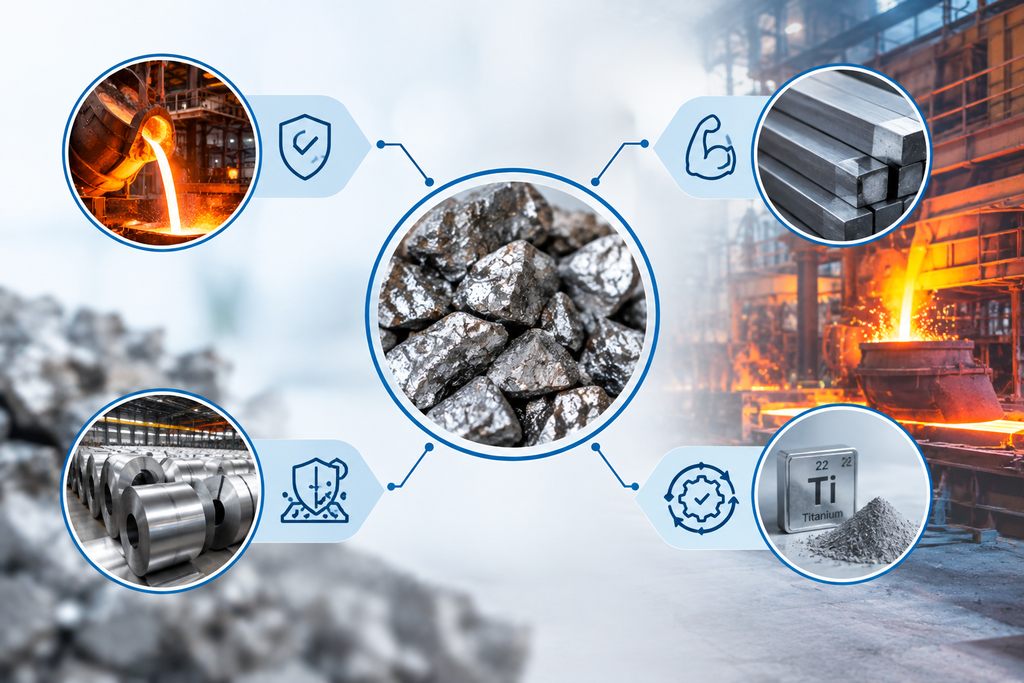
It is easy to look at ferro titanium as simply a source of titanium.
In practice, its role is more connected to controlled alloying.
A steelmaker needs to answer several questions:
- How much titanium is already present?
- What is the target range?
- What ferro titanium grade is being used?
- How much titanium is expected to recover?
- What is the steel temperature?
- What are the oxygen and slag conditions?
- How will the alloy be added?
- How quickly will it dissolve?
- What does the final analysis show?
When these points are monitored together, the plant has a much better chance of hitting the required titanium level consistently.
What Happens If Titanium Is Too Low?
If the final titanium level is below the required range, the intended metallurgical effect may not be achieved.
For example, if titanium is being used for a specific microalloying purpose, an insufficient addition can change the expected precipitation or grain-refining behaviour.
It can also create variation between heats.
This is one reason why steel plants monitor ladle chemistry before finalizing the heat.
The solution is not always simply “add more ferro titanium.” The plant first needs to understand why the recovery or final titanium level was lower than expected.
What Happens If Titanium Is Too High?
Adding more titanium is not automatically better.
Excess titanium can change the precipitation behaviour of titanium compounds. In titanium-containing steels, controlling Ti and N is particularly important because excessive or coarse TiN particles can negatively affect the desired microstructure.
This is why controlled addition is more useful than simply increasing the ferro titanium quantity.
The goal is generally to reach the required chemistry without unnecessary excess alloy addition.
A Simple Example
Consider a steel heat where the steelmaker needs to increase the titanium level by a certain amount.
The plant knows the titanium content of its ferro titanium and has historical data showing that only a certain percentage of the added titanium is normally recovered.
Instead of calculating the addition using the ferro titanium’s titanium percentage alone, the expected recovery is included.
For example, if a calculation assumes 100% recovery when the actual process normally achieves lower recovery, the final titanium level can fall below target.
This is why production teams often develop recovery factors based on their own plant data.
The exact calculation will depend on the steel grade and process, but the principle remains the same:
Know the alloy chemistry + understand your recovery + control the addition.
What Should Steelmakers Check When Buying Ferro Titanium?

Price is naturally important, but it should not be the only point considered.
Before finalizing a ferro titanium supplier, it is worth checking:
1. Titanium Content
Make sure the supplied grade matches the requirements of your steelmaking process.
2. Impurity Levels
Ask for information on elements that are important for your steel grade, particularly where tight chemistry control is required.
3. Size Range
Check whether the ferro titanium size is suitable for your charging or feeding system.
4. Batch Consistency
Ask whether the supplier provides batch-wise chemical analysis and identification.
5. Packaging
The material should arrive in suitable packaging that protects it during storage and transportation.
6. Supply Reliability
A good material is of limited use if the required quantity cannot be supplied when production needs it.
7. Trial Performance
Where possible, test the material under actual plant conditions before moving into regular bulk supply.
This gives the production team an opportunity to compare actual recovery and handling behaviour rather than making the decision only from a specification sheet.
Why Supplier Quality Still Matters
There is sometimes a tendency to treat ferroalloys as simple commodities.
For steel plants, they are not always that simple.
A small difference in chemistry, sizing, moisture, handling or batch consistency can affect how an alloy behaves during production.
This is why supplier communication matters.
If the supplier understands the importance of consistent alloy chemistry and documentation, it becomes easier for the steel plant’s purchasing and production teams to work with the material over time.
Ferro Titanium and Better Steelmaking Control
Ferro titanium does not control titanium levels by itself.
The alloy is one part of a larger process.
The steel plant still needs accurate weighing, suitable addition timing, good slag and oxygen control, proper mixing and final chemical analysis.
But ferro titanium gives the steelmaker a practical and measurable way to introduce titanium into the heat.
When the alloy quality is consistent and the addition practice is well understood, the plant can improve its ability to reach the desired titanium range from heat to heat.
That is the real value of ferro titanium: not simply adding titanium, but adding it in a controlled and repeatable way.
How Dsalloyd Pvt Ltd Can Support Your Alloy Requirements
For steel and alloy manufacturers, dependable raw material supply is an important part of maintaining production consistency.
Dsalloyd Pvt Ltd supplies alloy materials for industrial and metallurgical applications, including Manganese Metal Flakes and Noble Alloys. Its product range includes Ferro Molybdenum, Ferro Vanadium, Ferro Niobium and other ferroalloy materials.
The company also focuses on quality control, R&D and reliable supply for industrial customers.
If your company is looking for consistent alloy materials for steelmaking or other industrial applications, you can discuss your material requirements with Dsalloyd Pvt Ltd.
Explore the company’s alloy range at Dsalloyd Pvt Ltd.
Frequently Asked Questions
Ferro titanium is mainly used as a practical source of titanium during steelmaking. Controlled titanium additions can support microalloying, grain refinement and precipitation-related properties depending on the steel grade.
No. Recovery depends on several process conditions, including oxygen level, slag chemistry, temperature, addition method and bath conditions.
Recovery tells the steelmaker how much of the added titanium actually contributes to the final steel chemistry. Understanding recovery helps the plant calculate additions more accurately.
Titanium can influence grain structure and the formation of compounds such as TiN and TiC. The required level depends on the steel grade and the intended metallurgical effect.
Yes. Particle size can influence feeding, dissolution and addition behaviour. The appropriate size depends on the steel plant’s charging or feeding method.
Chemical composition, titanium content, impurity levels, particle size, batch consistency, documentation, packaging and supply reliability are some of the main points to check.
A trial allows the steel plant to see how the material behaves under its actual process conditions and compare recovery, handling and final chemistry before making a long-term commitment.
Not necessarily. The grade and addition practice should be selected according to the steel chemistry, required titanium level and production process.
Final Thoughts
Controlling titanium in steelmaking is more complicated than simply calculating how much ferro titanium to put into a heat.
The final result depends on the quality of the alloy, expected recovery, addition method, steel temperature, oxygen and slag conditions, and the plant’s own process control.
That is why steelmakers should look at ferro titanium as part of a complete alloying practice.
A consistent ferro titanium supply, combined with good process data and accurate final analysis, can make titanium control much more predictable.
And in steelmaking, predictable chemistry is often what makes the difference between one heat and the next.
