

High-Purity Vanadium Pentoxide
Vanadium pentoxide is one of those industrial materials that may not get much attention outside the metals and chemical industries, but it has an important role in modern manufacturing.
It is used in steel and alloy production, catalysts, glass and ceramics, pigments, and energy storage applications. Because it can be used in different processes, buyers often look beyond just the price per tonne when sourcing vanadium pentoxide. Purity, physical form, consistency, packing, documentation and supply reliability can all affect how useful the material is in actual production.
This is where the difference between a regular supplier and a trusted vanadium pentoxide supplier becomes noticeable.
A supplier may offer the right product on paper. But can they supply the same quality again next month? Can they maintain the required purity? Is the material packed properly? Can they provide the required documentation? And most importantly, do they understand what industrial buyers actually need?
These questions matter more than they may seem.
What Is High-Purity Vanadium Pentoxide?
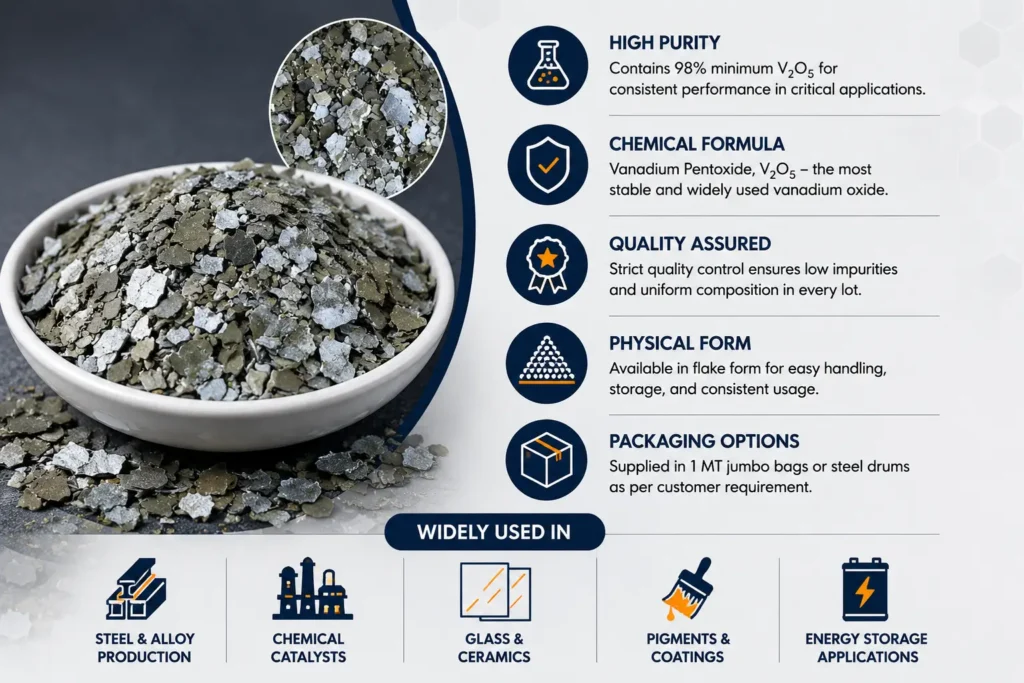
Vanadium pentoxide, commonly written as V₂O₅, is the most common oxide of vanadium. It generally appears as a yellow, orange or reddish solid depending on its form and processing.
For industrial use, vanadium pentoxide is available in different grades and physical forms, including flakes, granules and powders. The required form depends on the application and how the material is introduced into the production process. Commercial specifications can vary considerably, so buyers should always compare the complete specification rather than looking at the V₂O₅ percentage alone.
For example, DS Alloyd currently lists 98% minimum V₂O₅ in flake form, with packing options including 1 MT jumbo bags and steel drums, or as required by the customer.
That may sound like a simple specification, but there is more to quality than one number.
Purity Is Important, But It Is Not the Whole Story
When buyers ask for high-purity vanadium pentoxide, the first thing they normally check is the V₂O₅ content.
That makes sense.
Higher purity means there is a greater proportion of the material that contributes the required vanadium value. But experienced buyers usually look further into the analysis.
Elements such as iron, silicon, phosphorus and other unwanted constituents can also matter depending on the final application. Published industrial specifications for vanadium pentoxide show that these impurities can be controlled within defined limits, and different applications may require different impurity levels.
So instead of asking only:
“What is the V₂O₅ percentage?”
a better question is:
“What does the complete chemical analysis look like?”
This small change in the way a buyer evaluates the material can prevent problems later.
Why Physical Form Matters Too
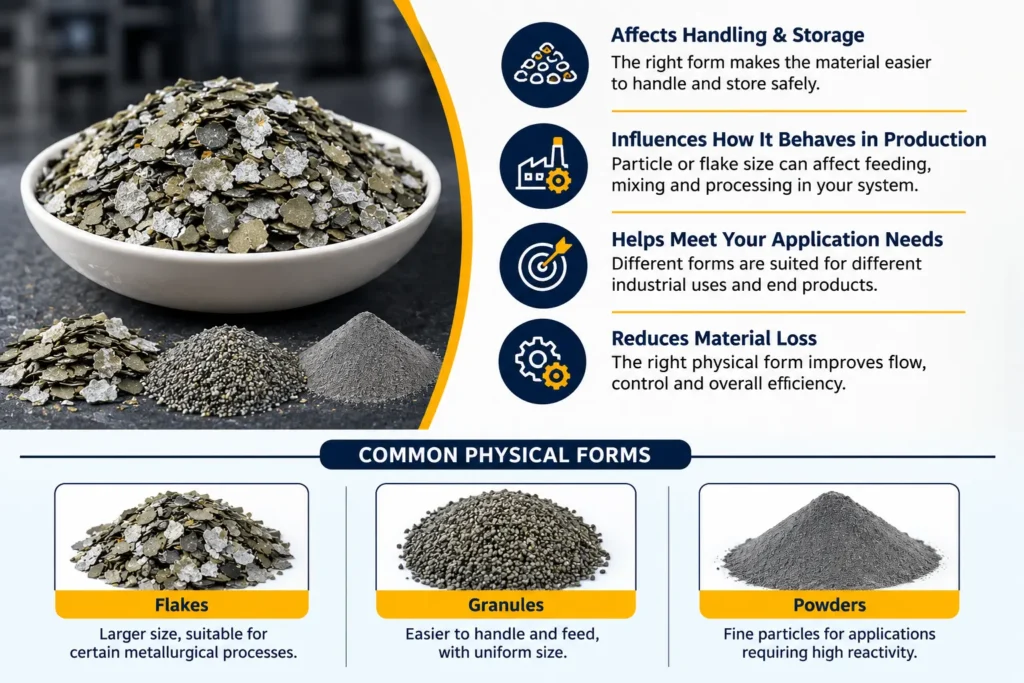
Vanadium pentoxide is not always purchased in the same physical form.
Some production processes may prefer flakes, while others may require finer material. The physical form can affect handling, feeding, storage and how the material behaves during processing.
For metallurgical applications, for example, the way a material is added to a furnace can influence material recovery and handling losses. Finer material may behave differently from larger flakes, particularly where dust generation or feeding control is a concern.
This is why a good supplier should not simply ask, “How many tonnes do you need?”
They should also understand:
- Required V₂O₅ purity
- Physical form
- Size requirements
- Packaging
- End application
- Monthly or annual consumption
- Delivery schedule
The more clearly these points are understood, the easier it becomes to supply the right material.
Consistency Is What Industrial Buyers Really Need
One shipment meeting the specification is good.
Five or ten shipments meeting the same specification is much more valuable.
Industrial production is built around repeatability. If a raw material changes significantly from one lot to another, the production team may have to make adjustments. Sometimes those changes are small and manageable. Sometimes they can affect yield, processing conditions or final product quality.
This is particularly important for companies buying materials regularly.
A trusted supplier should therefore focus on batch-to-batch consistency, not just passing one laboratory test.
This is also why quality control needs to happen throughout the supply process rather than only at the final dispatch stage.
What Should Buyers Check Before Selecting a Supplier?
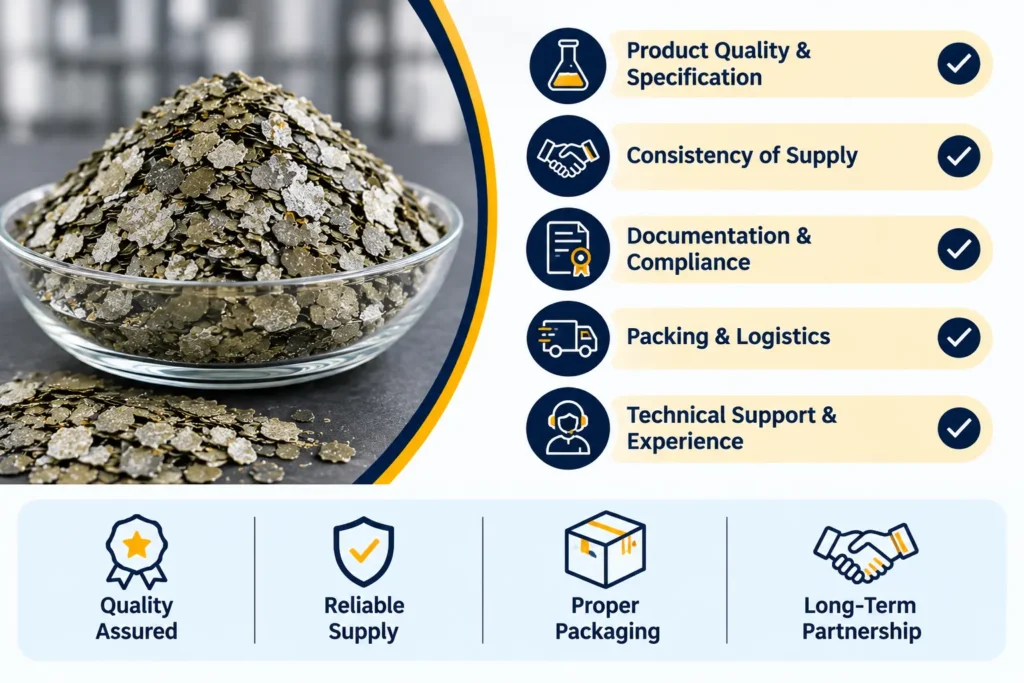
There are a few practical questions that can help buyers separate an experienced supplier from a trading source that simply has material available.
1. Is the chemical specification clearly defined?
The supplier should be able to clearly state the V₂O₅ content and relevant impurity limits.
Avoid vague descriptions such as “high purity” without an actual specification.
2. Can the supplier maintain the same grade regularly?
A supplier may have a good lot available today. But industrial buyers normally need a dependable supply rather than a one-time purchase.
Ask about regular availability and expected lead times.
3. Is the physical form suitable for your process?
Flakes, granules and powders do not behave exactly the same way.
The supplier should be able to provide the form that matches your application and handling requirements.
4. Is the material properly packed?
Good packing is easy to overlook.
However, industrial materials can be exposed to moisture, contamination and handling damage during storage and transportation. Suitable packaging helps protect the material until it reaches the customer’s facility.
5. Does the supplier understand industrial requirements?
A good supplier should be comfortable discussing specifications, quantity, packaging, documentation and delivery schedules.
That usually makes communication much easier for procurement and production teams.
Documentation Should Not Be an Afterthought
For industrial raw materials, paperwork is part of the product.
Buyers may need a certificate of analysis, specification sheet, packing details, batch information and other technical documents depending on their internal quality system.
This becomes particularly important when the material is being used in a controlled manufacturing process.
A supplier who can provide clear and consistent documentation makes it easier for the buyer’s quality team to verify incoming material.
It also creates a proper record if there is ever a question about a particular batch.
Supply Reliability Can Be More Valuable Than a Lower Price
Price will always matter.
But the lowest quoted price does not necessarily mean the lowest actual cost.
Imagine a manufacturer purchases a cheaper material, but the next shipment has different physical characteristics or a different impurity profile. The production team may need to make adjustments, conduct additional testing or deal with lower recovery.
That can quickly reduce the benefit of the original price difference.
For this reason, many experienced industrial buyers consider total supply value rather than simply comparing the price per kilogram or tonne.
A dependable supplier can help reduce uncertainty.
And in industrial manufacturing, reducing uncertainty is valuable.
Why Supplier Experience Matters
Vanadium pentoxide is a technical industrial material. Buyers don’t necessarily need a supplier that simply knows how to sell it. They need a supplier that understands how industrial customers evaluate alloy and metal materials.
DS Alloyd, for example, works across the ferroalloy and noble alloy segment and lists products including ferro molybdenum, ferro vanadium, ferro niobium, manganese metal flakes and vanadium pentoxide. The company also highlights quality control, technical expertise and supply reliability as part of its approach.
For a buyer, this broader product knowledge can be useful because vanadium pentoxide is often purchased alongside other alloying materials.
The supplier relationship becomes more useful when the supplier understands the bigger picture instead of treating every order as a separate transaction.
Where Is Vanadium Pentoxide Used?
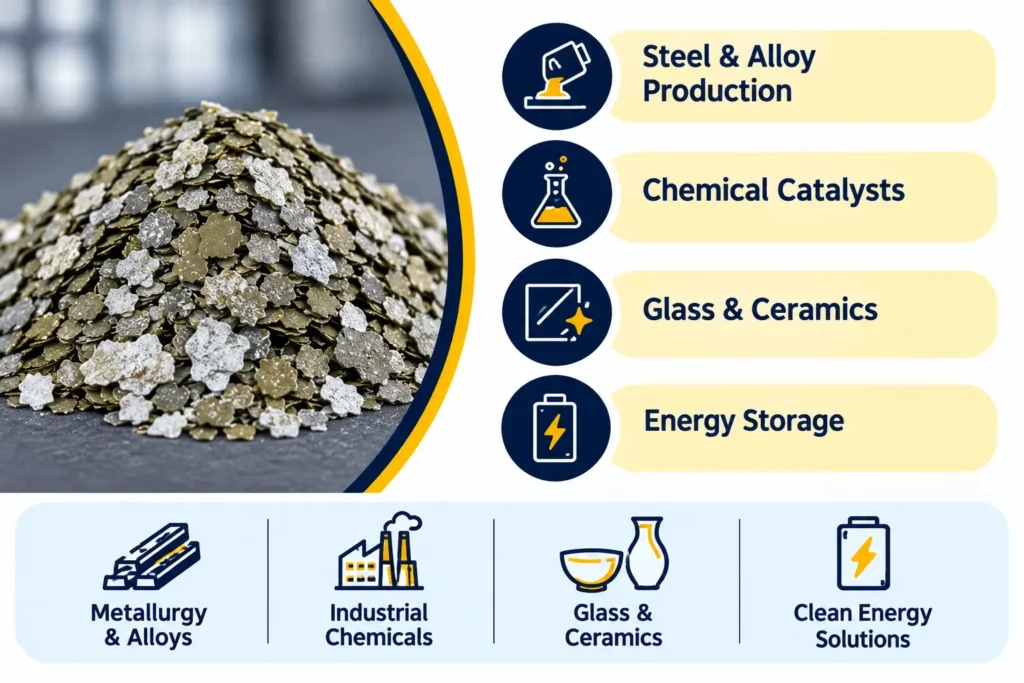
Vanadium pentoxide has a fairly broad industrial application range.
Steel and Alloy Production
Vanadium is used in alloy steels where it can contribute to strength, hardness and other performance characteristics. Vanadium pentoxide can serve as a source of vanadium in metallurgical applications.
Chemical Catalysts
V₂O₅ is widely known for its catalytic properties and is used in chemical processes, including sulfuric acid production.
Glass and Ceramics
Vanadium compounds can be used to influence the colour and properties of glass and ceramic materials.
Energy Storage
Vanadium pentoxide is also an important material in vanadium-based energy storage technologies, including vanadium redox flow batteries.
This wide range of applications is another reason why the required specification can vary from one customer to another.
A Trusted Supplier Should Ask Questions Too
This is something buyers sometimes overlook.
A supplier who immediately quotes a price without asking about the required grade, quantity, physical form or application may not be giving you the best service.
A more useful supplier will ask questions first.
For example:
What purity do you require?
Do you need flakes or another form?
What quantity do you consume monthly?
Is the material being used for metallurgy, chemicals or another application?
What packaging do you prefer?
These questions are not meant to complicate the purchase. They help make sure the material being offered actually matches the buyer’s requirement.
Choosing a Vanadium Pentoxide Supplier: A Simple Checklist
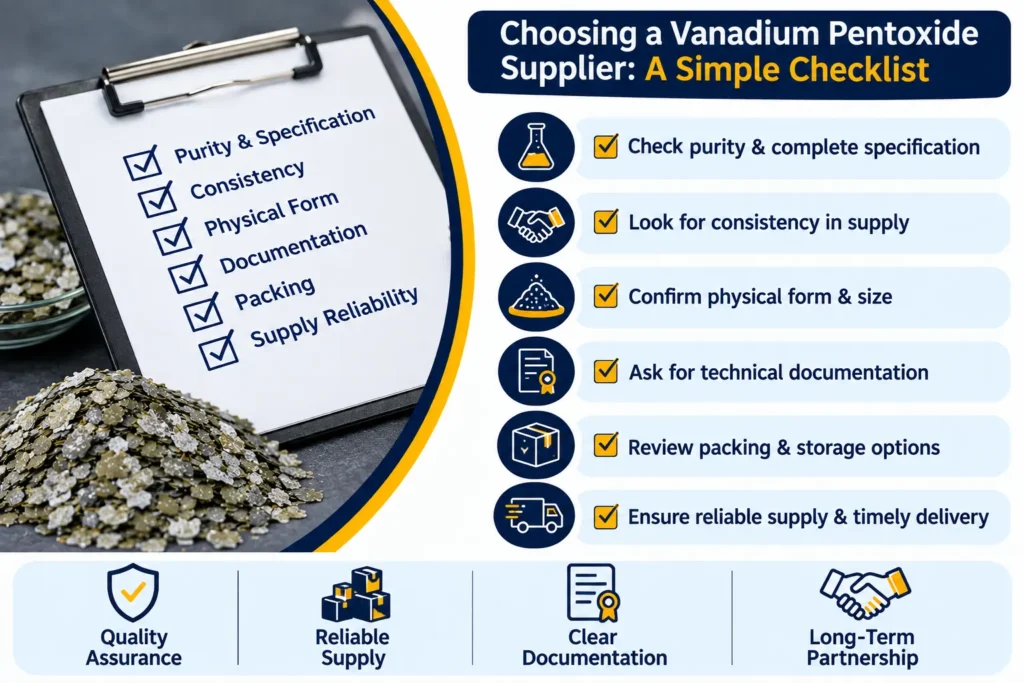
Before placing a bulk order, buyers can keep this checklist handy:
- Check the actual V₂O₅ percentage.
- Review important impurity limits.
- Confirm the physical form and size.
- Ask for technical documentation.
- Check packaging options.
- Discuss regular supply availability.
- Confirm delivery timelines.
- Ask whether samples are available for evaluation.
- Compare consistency, not only price.
- Choose a supplier that understands your application.
It is a simple approach, but it can save a lot of trouble later.
Why DS Alloyd Can Be a Practical Supply Partner
For companies looking for industrial alloy materials, DS Alloyd Pvt Ltd offers a range that includes vanadium pentoxide, manganese metal flakes and noble alloys such as ferro molybdenum, ferro vanadium and ferro niobium.
The company states that its quality approach includes quality checks, R&D support, skilled manpower and a focus on timely supply.
For buyers, the main advantage is having a supplier that understands the requirements of steel, alloy and other industrial manufacturing environments.
If your requirement is for high-purity vanadium pentoxide, the right approach is to discuss the required purity, form, quantity and application before finalising the order.
Talk to DS Alloyd about Vanadium Pentoxide and Alloy Materials
Final Thoughts
High-purity vanadium pentoxide is not simply about buying a material with a high V₂O₅ number.
For industrial buyers, the bigger picture includes purity, impurity control, physical form, consistency, documentation, packing and reliable supply.
A supplier that can manage all these points is much more valuable than one that only offers a competitive quotation.
And that is really what separates a trusted supplier from an ordinary one.
When the material becomes part of your regular production process, consistency starts to matter just as much as price.
Frequently Asked Questions
Vanadium pentoxide, or V₂O₅, is an oxide of vanadium used in industries such as steelmaking, chemical processing, glass and ceramics, pigments and energy storage.
It depends on the application. Commercial material is available in different purity levels and physical forms. Buyers should select the specification based on their actual production requirements rather than choosing a grade only because it has a higher purity number.
Yes. Flakes, granules and powders can have different handling and feeding characteristics. The appropriate form depends on the production process.
Check V₂O₅ purity, impurity levels, physical form, particle or flake size where applicable, packing, documentation, availability and consistency between batches.
Yes. Vanadium is used as an alloying element in steel, and vanadium pentoxide can be used as a vanadium source in metallurgical applications.
Look for a supplier that can provide a clear specification, consistent material, proper documentation, suitable packaging and dependable supply. It is also useful to work with a supplier experienced in ferroalloys and related industrial materials.
Yes. DS Alloyd lists vanadium pentoxide as part of its product range and currently specifies a minimum V₂O₅ content of 98% in flake form.
