

High-Quality Ferro Titanium Manufacturer
Introduction
When steel manufacturers purchase Ferro Titanium, they are not simply buying an alloy. They are investing in a material that directly affects the quality and performance of the steel they produce.
Because of this, the manufacturing standards followed by a Ferro Titanium producer matter just as much as the product itself.
Many suppliers may offer similar specifications on paper, but the way Ferro Titanium is manufactured, tested, stored, and delivered can vary from one company to another. These differences often become visible only after the material reaches the furnace.
For industrial buyers, understanding what defines a high-quality Ferro Titanium manufacturer can help reduce production risks, improve alloy recovery, and ensure consistent steel quality over the long term.
In this article, we’ll explore the manufacturing practices that separate dependable suppliers from ordinary ones.
Why Manufacturing Standards Matter
In steelmaking, consistency is essential.
Production teams carefully control furnace temperatures, chemical composition, and process timing. If the alloy materials vary from one shipment to another, maintaining the same level of steel quality becomes much more difficult.
A manufacturer that follows strict production standards helps customers receive material with predictable performance, reducing unexpected process changes and improving production efficiency.
Good manufacturing standards also help build trust between suppliers and customers.
What Is Ferro Titanium?
Ferro Titanium is a ferroalloy made from iron and titanium. It is widely used in steelmaking as a source of titanium.
Titanium plays an important role in improving steel by:
- Refining grain structure
- Reducing unwanted impurities
- Improving strength
- Increasing toughness
- Enhancing weldability
- Supporting better mechanical performance
These benefits make Ferro Titanium valuable in the production of structural steel, stainless steel, engineering steel, and specialty alloy grades.
Manufacturing Standards That Define a Reliable Ferro Titanium Producer
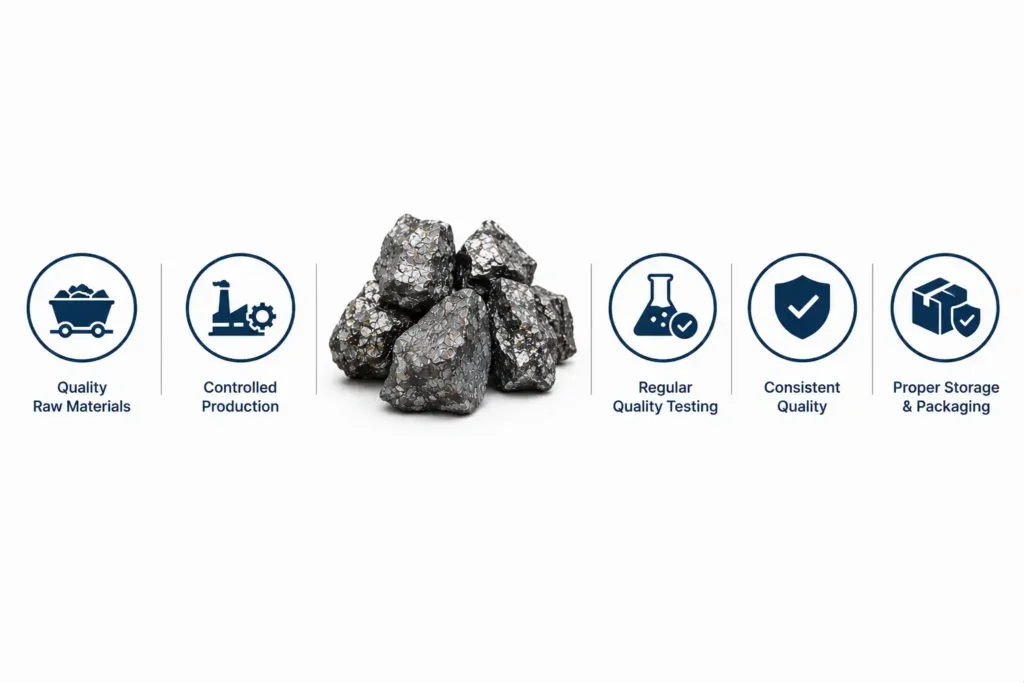
Careful Selection of Raw Materials
Quality begins before production starts.
Reliable manufacturers choose raw materials that meet strict quality requirements.
Poor-quality raw materials can introduce unwanted impurities that affect the final alloy.
By starting with better inputs, manufacturers improve consistency throughout the entire production process.
Controlled Production Processes
One characteristic of a dependable manufacturer is process control.
Every stage of production should follow defined procedures rather than relying on manual adjustments or inconsistent practices.
Maintaining controlled production conditions helps ensure each batch performs similarly in steelmaking.
This consistency is especially important for manufacturers producing high-strength steel.
Consistent Chemical Composition
Industrial buyers expect every shipment to match the agreed specifications.
A high-quality manufacturer monitors chemical composition throughout production to minimize variation between batches.
Consistent chemistry helps steelmakers:
- Predict alloy recovery
- Maintain stable production
- Reduce process corrections
- Produce uniform steel grades
This reliability becomes increasingly valuable during large-scale manufacturing.
Regular Laboratory Testing
Testing is not just a final step.
Professional manufacturers carry out inspections during different stages of production.
These may include:
- Chemical composition analysis
- Impurity testing
- Batch verification
- Physical inspection
Routine testing helps identify potential issues before products are delivered to customers.
Particle Size Consistency
One factor that often receives less attention is particle size.
Even when the chemistry is correct, inconsistent particle sizes can affect melting behavior and alloy recovery.
Manufacturers that carefully control sizing provide material that behaves more predictably during steelmaking.
This small detail can contribute to better furnace efficiency.
Clean Storage and Packaging
Quality should remain protected after production.
Reliable manufacturers store Ferro Titanium in clean, dry environments and use suitable packaging to reduce contamination during transportation.
Proper storage also helps maintain product condition until it reaches the customer’s facility.
The Difference Between Product Quality and Manufacturing Quality
Many buyers evaluate only the specification sheet.
However, two products with similar chemical compositions may perform differently if they were manufactured under different conditions.
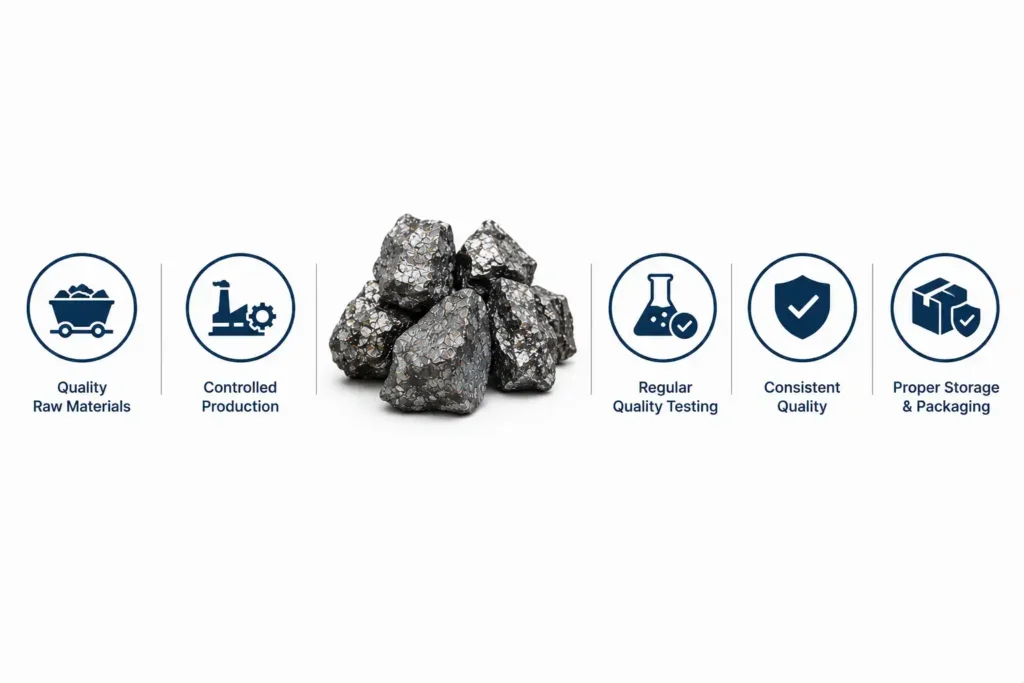
Manufacturing quality includes factors such as:
- Process stability
- Equipment reliability
- Quality control systems
- Employee experience
- Inspection procedures
- Batch traceability
These factors influence how consistently the product performs over time.
Why Consistency Is More Valuable Than the Lowest Price
Price is always an important consideration.
However, choosing a supplier based only on cost can sometimes create unexpected expenses later.
Low-quality or inconsistent Ferro Titanium may lead to:
- Additional alloy consumption
- Process adjustments
- Lower recovery rates
- Increased production downtime
- Product quality variations
- Higher operating costs
When viewed over months or years, dependable quality often provides greater value than a lower purchase price.
Questions Buyers Should Ask Before Selecting a Manufacturer

A good supplier should be able to answer practical questions about their manufacturing process.
For example:
- How is product quality monitored?
- How often are production batches tested?
- Can the supplier maintain consistent specifications?
- How is material stored before shipment?
- What quality documentation is available?
- How are customer complaints investigated and resolved?
These questions help buyers better understand the manufacturer’s commitment to quality.
Why Experience Still Matters
Manufacturing equipment is important, but experience is equally valuable.
Manufacturers that have worked with steel plants and foundries over many years often understand the practical challenges customers face.
Their knowledge can help improve communication, solve technical issues more quickly, and support consistent supply.
Experience often becomes one of the strongest indicators of long-term reliability.
Industries That Depend on Ferro Titanium
Ferro Titanium is used across many industries where steel performance is critical.
Some common applications include:
- Construction
- Automotive manufacturing
- Aerospace
- Oil and gas
- Railways
- Heavy engineering
- Power generation
- Industrial equipment manufacturing
As these industries continue demanding stronger and cleaner steels, reliable Ferro Titanium manufacturing becomes even more important.
Building Long-Term Value Through Better Manufacturing
The best manufacturers do more than produce alloy materials.
They create confidence.
When customers receive the same quality product every time, production planning becomes easier, quality becomes more predictable, and long-term business relationships become stronger.
This is why experienced steelmakers often look beyond price and focus on manufacturing standards, consistency, and reliability.
A dependable manufacturer becomes an important part of the customer’s production process.
Looking for Reliable Alloy Material Solutions?
Choosing quality alloy materials is an important step toward producing reliable steel products.
Dsalloyd Pvt Ltd supplies premium Manganese Metal Flakes and Noble Alloys for steel plants, foundries, and industrial manufacturing businesses. The company focuses on dependable quality, consistent supply, and customer satisfaction to help industries achieve efficient and reliable production.
If your business is looking for trusted alloy material solutions, visit https://www.dsalloyd.com/ to explore the product range and connect with the team.
Strong manufacturing begins with dependable raw materials.
Frequently Asked Questions (FAQs)
Ferro Titanium is used in steelmaking to introduce titanium into molten steel, improving strength, toughness, grain refinement, and steel cleanliness.
Strong manufacturing standards help ensure consistent quality, reliable alloy recovery, and predictable performance during steel production.
Look for consistent quality control, laboratory testing, controlled production processes, proper storage, and industry experience.
Yes. Uniform particle size helps improve melting behavior, alloy recovery, and overall process consistency.
Consistent batches reduce production adjustments and help maintain stable steel chemistry throughout manufacturing.
Construction, automotive, aerospace, oil and gas, railways, heavy engineering, and power generation industries commonly use Ferro Titanium.
Not always. Lower-priced materials can lead to higher production costs if quality or consistency is poor.
Manufacturers can explore the metallurgical products offered by Dsalloyd Pvt Ltd, including Manganese Metal Flakes and Noble Alloys, for dependable industrial applications.
